
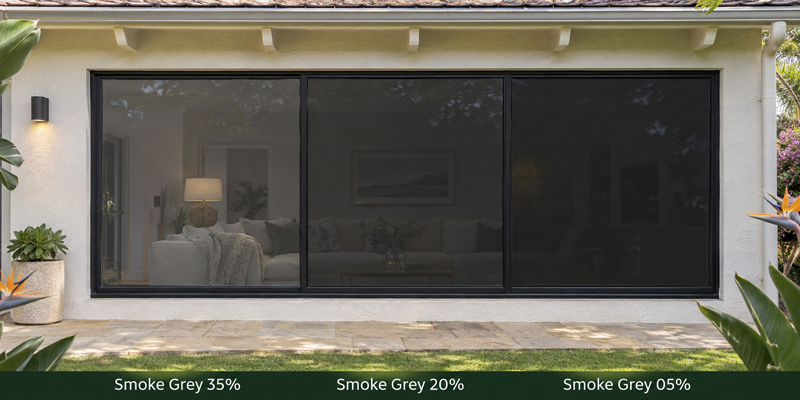
Smoke Grey Window Film for Homes: Which Shade Suits Your Room?
Afternoon sun can make a lounge screen difficult to see or leave you squinting at your laptop in a home office. SFF’s Smoke Grey Window Film softens harsh daylight and gives residential windows a neutral grey, non-reflective finish. The best shade depends on what you want from the room. Do you want to take the edge off the glare while keeping the space bright, or would you prefer a deeper tint for watching TV?
SFF offers three residential window tint shades. Smoke Grey 35% lets in the most daylight, Smoke Grey 20% offers a middle ground, and Smoke Grey 05% provides the strongest glare reduction. All three reject over 99% of UV under the stated test conditions.
Compare SFF Smoke Grey residential window film shades
Visible light transmission (VLT) measures how much visible light passes through the filmed glass. A lower figure means a darker window. The shade names are product labels, while the tested VLT figures below show how each film performed on 3 mm glass.
| Smoke Grey shade | Tested VLT | Glare reduction | Total solar energy rejected | UV rejected | SFF product code |
|---|---|---|---|---|---|
| 35% | 40% | 56% | 33% | Over 99% | WF-NR2-020 |
| 20% | 22% | 76% | 39% | Over 99% | WF-NR2-019 |
| 05% | 5% | 95% | 42% | Over 99% | WF-NR2-018 |
Source: SFF technical data sheets. All three films have a 2-ply construction and a thickness of 1.5 mil. Performance can vary with the glass and production batch.
Which tint works best in a lounge, home office or TV room?
For a living area where you enjoy natural light, start with Smoke Grey 35%. This is the lightest shade in the range, yet it reduces glare by 56% on test glass. It’s a good first sample to try in a lounge or dining room where you enjoy the afternoon light but often find yourself drawing the curtains.
For a home office with persistent screen glare, consider Smoke Grey 20%. It reduces glare by 76% and gives the window a deeper grey appearance. If sunlight reaches your desk at a particular time each day, compare the 20% and 35% samples from your chair at that hour. You’ll get a better sense of both screen comfort and how bright the rest of the room feels.
For a TV or media room where you prefer a dimmer setting, consider Smoke Grey 05%. This shade delivers 95% glare reduction and allows just 5% of visible light through the test glass. If the room also serves as your main family living space, compare it with the 20% shade before committing to the darker finish.
How much solar heat does Smoke Grey Window Film reject?
If heat is your main concern, look at total solar energy rejected (TSER) alongside the shade. Smoke Grey 20% rejects 39% of total solar energy on test glass, while Smoke Grey 05% rejects 42%. Choosing the darkest film gains three percentage points of solar energy rejection, but visible light transmission falls from 22% to 5%. For a room you use throughout the day, that difference in daylight may matter more to you.
Does Smoke Grey Window Film provide privacy at home?
A deeper grey tint can make it harder to see into a room during the day when it’s brighter outdoors. After sunset, switching on interior lights can make the room visible from outside. For bedrooms or street-facing lounges where evening privacy matters, keep curtains or blinds as part of your window treatment.
Where to buy Smoke Grey Window Film in South Africa
Visit SFF’s retail store in Durban North to compare the shades, or browse SFF Online. Before ordering, ask your installer to confirm that your chosen film is compatible with your existing glass. If you’re deciding between two shades, view both samples on the window that gets the strongest afternoon sun. That’s where you’ll see which one gives you the balance of glare control and daylight you want.